
Douglas County Multi-Day Arrest Log
Douglas County publishes no separately branded weekly or 72-hour blotter. The official route is a wider date range inside the DCSO Booking Search. Set a Booking From Date and a Booking To Date. Span three days, seven days, or any window you choose. What comes back is a date-range view you built yourself. It is not a county publication with a promised weekly issue date.
Other Douglas County logs answer different questions. DCSO FlashAlert posts narrative releases on notable incidents. City police logs cover activity that agency reported. That includes citations and events that never reach a county-jail booking. A solid multi-day check starts with jail records. It then treats agency narratives as added context rather than substitute data.
Read Douglas County Arrest Logs
Pick your window before you search. A true seven-day review needs explicit start and end dates. A weekend check should leave room for late updates. The Jail Viewer can also filter by release date and status. That separates people booked during the range. It also separates people released during it. Results shift fast, so jot down the date you checked.
- Open the official booking query and enter a clear Booking From Date and Booking To Date.
- Add a name only when tracing one person. Use the percent-sign wildcard carefully if spelling is uncertain.
- Read booking and release dates separately. A release does not erase the original intake record.
- Open detail links for the alleged charges or offenses that the portal currently makes available.
- Compare major incidents with FlashAlert or the relevant city police log, while remembering that neither is complete.
- For one-day activity, use the Daily Arrest Report and its tighter same-date method.
Each record answers a different question. A Douglas County jail entry tracks an intake into county custody. A city patrol log tracks that department's reported activity. FlashAlert highlights selected events. The court docket, meanwhile, records filed proceedings and their disposition. Never merge these into one count unless their dates and definitions truly match.
Douglas Arrest Log Fields
The Jail Viewer grid shows stable identity and date columns. Detail records may add alleged charges. City and news logs can layer on incident time, location, agency narrative, and disposition wording, though none of that is promised in the jail grid. Keep each fact tied to its source.
| Field | Source and limit |
|---|---|
| Booking number | Official jail reference used to distinguish separate intakes. |
| First, middle, last name | Official grid identity fields; confirm common names with more than one detail. |
| Race and sex | Descriptive jail fields; do not infer identity from them. |
| Booking date | Core date-range field; it may not supply a precise intake timestamp. |
| Release and scheduled release | Separate fields; a scheduled date is not a promise of actual release. |
| Charges or offenses | Original detention charges when shown, not the court's final ruling. |
| Incident details | May appear in a police log or release, not necessarily in the jail result. |
| Photo | May be included by the jail when configured and permitted; never guaranteed. |
Bond amounts, court dates, and outcomes can shift after booking. None are guaranteed in the result grid. Police-log verbs matter too. A word like arrested, cited, lodged, or transported changes the meaning of an entry. Lodged generally means delivery into custody. Cited may mean the person never reached the Douglas County Jail at all.
Douglas Weekend Arrest Records
Douglas County promises no fixed posting schedule. No official source says weekend arrests land on a Monday. None says holidays cause a set delay. None promises every booking shows up within a certain number of hours. The Jail Viewer states only that information is updated regularly. It can change quickly. Build a weekend range that covers each calendar date at issue. Then check again once the system has had time to finish intake work.
Don't fill a gap with a publisher's timestamp either. An outside site may gather data long after the county created it. A news article can run days after the event. For current custody, call Douglas County Corrections at 541-440-4440. For an older face sheet or booking document, contact DCSO Records at 541-440-4463. Bring the booking number or nearest known date.
Note: A multi-day query reduces missed dates, but it cannot prove completeness because Douglas County states no public archive-depth or refresh guarantee.
Douglas Arrest Archives and Retention
Online persistence is not legal retention. Douglas County does not promise how long the Jail Viewer returns an entry. Oregon's public-safety retention schedule does set minimum periods for government record series. Booking and criminal-arrest-history records carry minimums tied to offense class. The minimums run 20 years for homicides, 10 for felonies, and five for misdemeanors. Those rules do not promise public website access or release of a booking photo.
When an item vanishes from the web, start with DCSO Records. Ask for a county booking sheet or face sheet. A city incident report belongs with that city's police custodian. Court documents belong with the court that handled the case. The Douglas County historical inventory notes that commitment records created since 2014 are electronic. But that inventory is not a live booking archive.
Older material may sit with the county. It may also rest with a court, the Oregon State Archives, or another repository. Give the custodian a name, approximate date, agency, and record type. Sealed, expunged, juvenile, victim, medical, and other protected records can stay restricted. That can hold even when retention rules require the agency to keep them.
Douglas County Sheriff's Office Records1036 SE Douglas Avenue
Roseburg, OR 97470
Phone: 541-440-4463
Email: dcso.records@douglascountyor.gov
Douglas City Arrest Log Split
City police logs in Douglas County vary a lot. Roseburg moved its patrol log behind an email subscription. Sutherlin posts a media log on its city site. Winston publishes no public arrest blotter, so records requests remain the supported path for Winston arrests. City sources track police activity, not the DCSO jail roster.
For Roseburg patrol entries, the Roseburg Receiver police-log archive is the strongest unofficial option around. Entries can list case date, time, location, officers, people, alleged charges, details, and disposition. The site credits city patrol-log material as its base. It is not run by Roseburg or DCSO.
The Receiver's own page shows how its Roseburg police-log archive is organized.
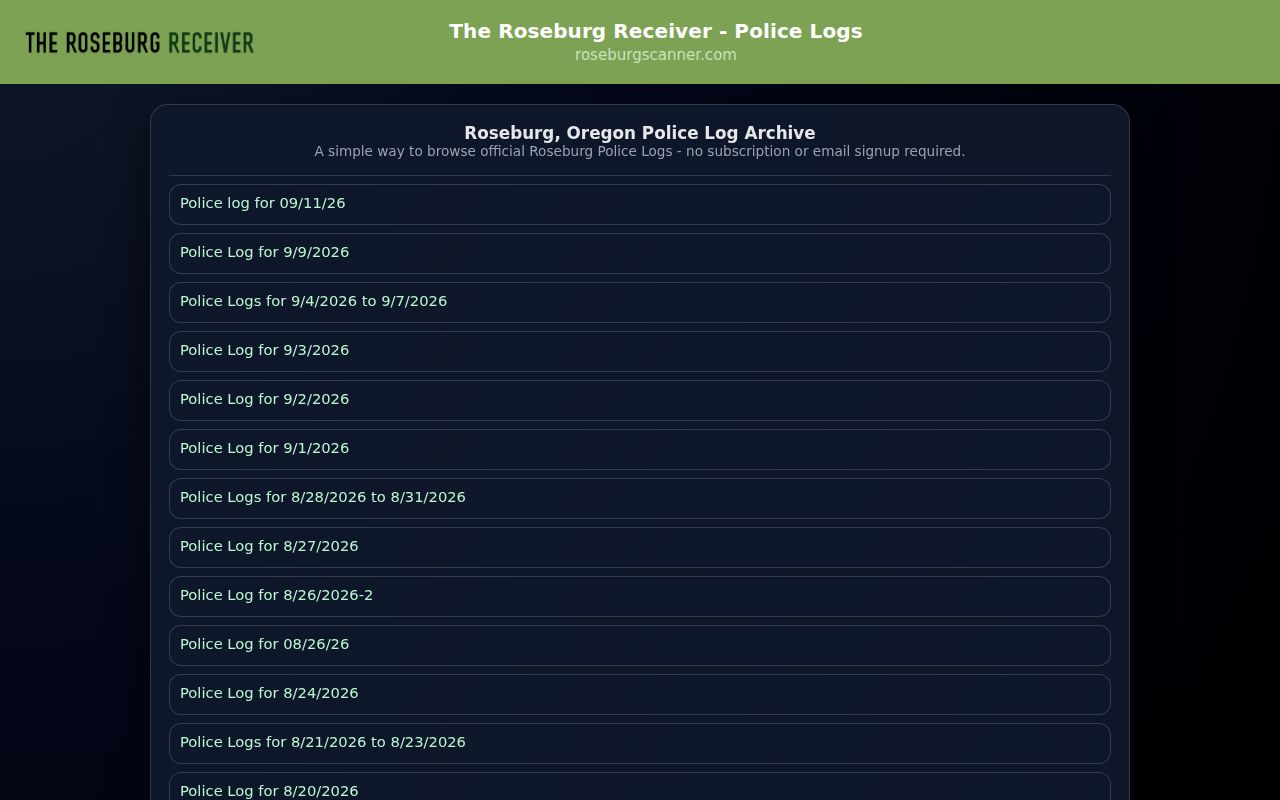
Treat an archived entry only as a lead. Confirm the arrest, custody status, and court outcome with the official office that handled the case.
Douglas Enforcement Log Limits
DCSO FlashAlert shares selected major incidents, alleged charges, and booking destinations. It is official. It is incomplete. Not everyone arrested appears there. Roseburg's emailed log and Sutherlin's periodic media logs show what each city chooses to publish. No countywide DUI-checkpoint or enforcement-blitz calendar stands in as a full arrest log.
Local newspapers add context, though coverage stays selective. The News-Review covers Douglas County crime, court, and public-safety stories, sometimes behind a subscription. Oregon News Herald publishes issue-based regional stories. Neither paper is a live feed, so keep story dates and event dates separate.
The News-Review site is one local source for selected Douglas County reporting.

A story can explain what happened. Booking status still comes from the Jail Viewer, and outcomes come from the court record. The Oregon News Herald home page shows its issue-based approach.

Check the issue date first. If the event falls outside your week, the story is not part of that arrest period.
Douglas Arrest Trends Need Context
The DCSO 2025 Year-End Report adds countywide context. It counted 4,168 bookings and 631 warrant arrests. Those numbers cover the report year alone. They are not a live export of the Jail Viewer, so dividing them into weekly totals or city arrest counts would mislead. The report also groups activity by county operating areas rather than booking-log fields.
Unofficial indexes can masquerade as trend data. RecentlyBooked says it refreshes several times per day and lists bookings by date, but that schedule belongs to the publisher, not DCSO. Arrests.org offers county and month directories that look archival. Neither proves completeness, live custody, or a final case outcome.
Verify any copied name, date, charge, or booking number against DCSO. For outcomes, the court record stands alone.
Note: Annual statistics, news stories, city logs, and jail bookings use different definitions, so they should not be combined into one trend line.